Live Wide Open.
A Brand Campaign for Bell Helmets
The Challenge
For decades, Bell has been deeply woven into two-wheeled culture. From racing and motocross to street riding and everyday cycling, the brand has always represented more than protection. It represents freedom, identity, rebellion, and community.
The challenge was that much of Bell’s marketing had become increasingly product-focused. While effective from a sales standpoint, it left less room to tell the larger emotional story behind why people ride in the first place.
LIVE WIDE OPEN was created to bridge that gap.
The goal was to build a brand campaign that could live alongside product marketing while reinforcing Bell’s cultural relevance and emotional connection to riders. Instead of focusing on features and specifications, the campaign needed to capture a mindset. Something bigger than a helmet. Bigger than a category.
The Approach
The strategy centered around a simple idea: riding changes the way people experience the world.
Whether on motorcycles, bicycles, or anything in between, two-wheeled culture has always been about openness. Openness to movement, exploration, individuality, and human connection. LIVE WIDE OPEN became both a rallying cry and a brand philosophy.
Rather than creating a polished, overly commercial campaign, the creative direction leaned into authenticity. Real riders. Real environments. Honest moments. The campaign was designed to feel lived-in rather than manufactured.
Visually, the work balanced cinematic storytelling with documentary-style energy. Wide landscapes, natural light, motion blur, imperfect framing, and human moments all helped reinforce the feeling of freedom and spontaneity. The tone avoided traditional adrenaline-heavy powersports tropes in favor of something more emotional and universal.
Design System & Execution
Because the campaign needed to scale across multiple channels, flexibility became a core part of the design system.
The visual language was built to work seamlessly across:
Digital campaigns
Social content
Print advertising
Environmental graphics
Retail executions
Brand films and motion content
Typography and layouts were intentionally restrained, allowing imagery and storytelling to carry the emotional weight. Messaging stayed concise and confident, acting as an extension of the imagery rather than competing with it.
The campaign also created space for multiple riding disciplines to coexist under one unified brand voice. Street riders, cyclists, racers, commuters, and explorers could all see themselves reflected in the work without the brand feeling fragmented.
Creative Decisions
A key decision was resisting the urge to over-brand the campaign. Bell’s presence was felt through tone, attitude, and cultural understanding rather than constant logo placement or aggressive messaging.
Another important choice was designing the campaign as a long-term platform rather than a seasonal promotion. LIVE WIDE OPEN was intentionally built to evolve over time, allowing new stories, riders, products, and experiences to plug into a consistent emotional framework.
This gave the brand a stronger connective thread across marketing efforts while also creating a more recognizable and ownable voice in the category.
The Outcome
LIVE WIDE OPEN helped reposition Bell as more than a product manufacturer. It reinforced the brand’s role as a genuine participant and champion of two-wheeled culture.
The campaign created a unifying narrative that could support product launches while simultaneously strengthening long-term brand equity. Across digital, print, environmental, and video executions, the work delivered a more human and emotionally resonant expression of the brand.
Most importantly, it reminded riders that Bell understands something fundamental about the culture: riding is not just about where you’re going. It’s about how open the world feels when you get there.
Bell 60th Mark
A Heritage Symbol Designed to Honor the Past and Signal the Future
The Challenge
Reaching a 60-year milestone is rare for any brand, especially one so deeply connected to motorsports, cycling, and two-wheeled culture. For Bell Helmets, the anniversary represented more than longevity. It was proof of decades spent shaping the culture of riding itself.
The challenge was to create a commemorative mark that could celebrate that legacy without feeling nostalgic or trapped in the past. The design needed to honor Bell’s history while still feeling relevant to a modern audience and adaptable enough to live across product collaborations, promotional campaigns, apparel, packaging, and digital experiences.
Most importantly, the mark had to feel unmistakably Bell.
The Approach
Rather than treating the anniversary logo as a decorative badge, the goal was to create a symbol that carried emotional and cultural meaning.
The creative direction began by looking at the visual language historically tied to the open road. Vintage road signs, highway iconography, and classic Americana became key sources of inspiration. These shapes immediately evoked movement, exploration, and freedom, ideas that have always sat at the center of Bell’s identity.
At the same time, the design process focused on restraint. The mark needed to feel timeless rather than overly stylized or trend-driven. Every element had to support clarity, flexibility, and longevity.
Design Decisions
The final mark drew heavily from the bold geometric forms found in classic road signage. The shape language created an immediate connection to travel and riding culture while subtly reinforcing Bell’s heritage.
Typography was treated with equal care. The balance between vintage influence and modern execution was intentional. Rather than recreating a retro aesthetic outright, the design borrowed recognizable cues from the past and refined them through a cleaner, more contemporary lens.
This balance became central to the system:
Familiar enough to feel rooted in history
Modern enough to signal momentum and evolution
Flexible enough to scale across multiple applications
The secondary mark was designed to work seamlessly alongside the core Bell identity rather than compete with it. It functioned as a celebratory layer within the broader brand ecosystem, allowing limited-edition collaborations and anniversary storytelling to feel elevated without disrupting overall brand consistency.
Special attention was also given to versatility. The mark needed to hold up equally well on helmets, apparel, packaging, signage, social media, and video content. Simplicity became a strategic advantage, ensuring the symbol remained recognizable and impactful across every execution.
The Outcome
The Bell 60th anniversary mark became more than a commemorative graphic. It evolved into a symbol of continuity between the brand’s legacy and its future.
Used across special promotions, collaborations, and branded experiences, the mark helped create a cohesive visual thread throughout the anniversary celebration while reinforcing Bell’s long-standing connection to riding culture.
The final result captured a difficult balance: honoring six decades of history without feeling stuck in it. It celebrated where Bell has been while expressing confidence about where the brand is headed next.
Intershop
Reframing a Legacy Technology Brand for the Modern Digital Commerce Era
The Challenge
For decades, Intershop has played a foundational role in digital commerce. Long before ecommerce became mainstream, the company was already helping businesses navigate the complexities of digital transactions, customer experiences, and online infrastructure.
But like many long-standing technology companies, Intershop faced a perception challenge.
The market had evolved rapidly. New competitors were entering the space with modern visual identities, simplified messaging, and polished digital experiences. While Intershop’s capabilities remained strong, the brand expression no longer reflected the innovation, strategic thinking, or sophistication behind the company itself.
The challenge was not to reinvent Intershop. It was to realign how the company looked and communicated with the level of expertise it had already built over decades.
The brand needed to feel:
Intelligent without feeling overly technical
Established without appearing dated
Enterprise-ready while remaining approachable
Forward-looking without abandoning its legacy
The Approach
The process began by looking beyond software features and focusing on the role Intershop actually plays for its clients.
At its core, the company helps businesses navigate transformation. It simplifies complexity. It creates structure inside fast-moving digital ecosystems. And most importantly, it enables companies to evolve with confidence.
That insight became the foundation for the brand story.
Rather than positioning Intershop purely as a software provider, the creative direction reframed the company as a strategic partner helping organizations transform digital challenges into business growth opportunities.
This shift influenced every aspect of the identity system, from messaging and typography to motion and layout behavior.
Design Decisions
A major priority was creating a visual language that could communicate sophistication and clarity simultaneously.
The design system leaned into precision, modularity, and movement. Clean grids, structured compositions, and refined typography reflected the logic and scalability of enterprise technology platforms, while more dynamic visual moments introduced a sense of adaptability and momentum.
The identity avoided many of the predictable visual tropes common in the technology sector. Instead of relying on overly futuristic graphics or abstract complexity, the work focused on confidence through simplicity.
Color, spacing, and composition were all intentionally restrained, allowing the brand to feel mature and credible without becoming cold or corporate.
Messaging also played a critical role. The language shifted away from feature-heavy communication toward outcome-driven storytelling. Rather than emphasizing technical specifications alone, the brand began speaking more directly about transformation, efficiency, growth, and long-term business value.
This helped Intershop communicate not only what it does, but why it matters.
Building for Flexibility
Because Intershop operates across multiple markets, industries, and enterprise touchpoints, flexibility became essential.
The identity system was designed to scale seamlessly across:
Digital platforms
Product marketing
Sales materials
Corporate communications
Trade shows and events
Motion graphics and presentations
Internal culture and recruitment initiatives
Consistency across these experiences helped unify the brand while allowing individual teams and business units room to adapt the system to their needs.
The Outcome
The final brand expression positioned Intershop as a modern leader in digital commerce without disconnecting from its history or expertise.
The refreshed identity brought greater clarity, cohesion, and confidence to the brand, helping the company better communicate its value in an increasingly competitive marketplace.
More importantly, the work helped shift perception. Intershop no longer looked like a company trying to keep up with digital transformation. It looked like a company helping define it.
The result was a brand system built not just to support today’s business, but to evolve alongside the future of digital commerce itself.
Blackburn Brand Relaunch
Rebuilding an Authentic Connection to Cycling Culture
The Challenge
For years, Blackburn had built credibility through reliable products, thoughtful engineering, and technical innovation. But somewhere along the way, the brand conversation became dominated by specs, features, and functionality.
The products worked. The messaging did not always connect emotionally.
The challenge was clear: people respected Blackburn, but they weren’t necessarily falling in love with it.
The brand needed to reconnect with the culture surrounding cycling itself, not just the equipment. Riders wanted authenticity. They wanted personality. They wanted brands that genuinely understood why they ride, not just what they ride with.
This relaunch became an opportunity to reposition Blackburn as more than a cycling accessory company. The goal was to create a brand that felt deeply embedded in the culture. Something human, expressive, adventurous, and undeniably real.
The Approach
The process started by immersing ourselves in the rhythms and rituals of cycling culture.
Not the polished version seen in advertising, but the real one:
Long rides that start before sunrise
Dirt-covered gear tossed in the back of a truck
Handwritten route maps
Coffee stops
Mechanical improvisation
Stories shared after the ride is over
The insight was simple: cycling is not driven purely by performance. It is driven by experience, identity, exploration, and community.
That understanding became the foundation for the relaunch.
Rather than creating a brand that spoke at cyclists, the goal was to make Blackburn feel like it came from cycling culture itself.
Building the Brand System
The relaunch extended far beyond a new logo or campaign. Every touchpoint was redesigned to create a more cohesive and emotionally resonant brand experience.
Identity
The visual identity embraced a more expressive and lived-in aesthetic. Typography, layouts, and graphic elements were designed to feel confident but unpretentious, balancing utility with personality.
The system intentionally avoided overly sleek or hyper-technical cycling industry tropes. Instead, the work leaned into authenticity, grit, and approachability, reflecting the diverse personalities within cycling culture itself.
Website
The website became less of a digital catalog and more of a storytelling platform.
Products still mattered, but they were now framed within a broader lifestyle narrative. Editorial-style photography, rider stories, and cultural cues helped create a more immersive experience that reflected how cyclists actually engage with the sport and community.
Social Media Campaign
Social content focused on human moments over polished perfection.
The campaign celebrated real riders, imperfect conditions, exploration, and everyday adventure. The tone became more conversational, observational, and culturally aware, helping Blackburn feel less like a corporation and more like a trusted participant within the community.
Brand Values & Positioning
A major part of the relaunch involved clarifying what Blackburn stood for beyond products.
The positioning centered around durability, exploration, independence, and a genuine love of riding culture. These values informed not only external messaging but also the internal decision-making behind future products, collaborations, and communications.
Industrial Design Language
The visual language extended into product design itself.
Materials, finishes, detailing, and form factors were considered through the lens of the new brand positioning. Products needed to feel rugged, purposeful, and adventure-ready without appearing overdesigned or trend-driven.
This helped create stronger continuity between the brand story and the physical product experience.
Packaging System
Packaging was redesigned to feel more tactile, informative, and emotionally connected to the brand.
The system balanced utility and storytelling, combining clear product communication with a visual tone that reinforced Blackburn’s cultural authenticity. The packaging became another opportunity to express the brand’s personality rather than simply house the product.
Collaboration & Creative Voice
Photography by Brian Vernor played a major role in grounding the relaunch in authenticity. The imagery captured cycling in a way that felt raw, honest, and emotionally connected to the riding experience.
Illustration work by Chris McNally added another layer of personality and storytelling, helping the brand system feel handcrafted and culturally embedded rather than overly corporate.
Together, these creative elements helped build a richer, more human visual world around the brand.
The Outcome
The Blackburn relaunch transformed the brand from a product-focused manufacturer into a more emotionally resonant voice within cycling culture.
The new identity system created consistency across every touchpoint while giving the brand greater personality, flexibility, and authenticity. More importantly, it helped Blackburn reconnect with riders on a deeper level by reflecting the values, experiences, and spirit that make cycling meaningful in the first place.
The result was not simply a rebrand. It was a cultural repositioning, one that allowed Blackburn to feel less like a company selling cycling products and more like a brand born directly from the ride itself.
Windows XP
Designing the Visual Identity of a New Digital Era
The Challenge
At the turn of the millennium, Microsoft was preparing to launch what would become one of the most influential operating systems in history: Windows XP.
The product represented a major shift for the company. Windows XP was designed to feel more human, approachable, connected, and visually immersive than previous versions of Windows. It was not simply a software update. It was a rethinking of how people emotionally interacted with personal technology.
To help shape that evolution, Microsoft brought in frog design to provide an outside creative perspective.
The mandate was expansive:
Explore the next-generation visual language for Windows
Design key user interface elements including taskbars and media player experiences
Help create a more cohesive emotional experience across the platform
Reimagine one of the most recognizable technology logos in the world
The challenge was enormous. The Windows identity carried decades of brand equity and global recognition. Any redesign needed to feel unmistakably familiar while also signaling a bold step into the future.
The Approach
The project began with a simple but important realization: Windows XP needed to feel alive.
Previous operating systems had largely prioritized utility and structure. XP introduced a more expressive and emotionally engaging relationship between people and technology. The interface was softer, brighter, more dimensional, and more optimistic.
That emotional shift became the guiding principle behind the design work.
Rather than treating the UI and branding as separate systems, the process focused on creating a unified visual language. Every element needed to feel connected, from the interface animations and media player interactions to the taskbar behaviors and brand identity itself.
The goal was not minimalism for its own sake. It was clarity, warmth, and accessibility inside an increasingly digital world.
Reimagining an Icon
Eventually, the work expanded into one of the project’s most visible and culturally significant components: the Windows logo.
The original Windows mark had become globally iconic. Its four-color arrangement of red, green, yellow, and blue carried deep recognition and symbolic meaning. The shape suggested both literal windows opening onto the world and flags representing exploration, movement, and discovery.
The challenge was preserving that recognition while evolving the identity to reflect a more fluid and user-friendly digital experience.
Our team developed fifty logo explorations ranging from subtle refinements to radical departures. The process examined:
Motion and dimensionality
Color vibrancy
Shape simplification
Visual energy
Scalability across digital environments
Emotional perception
The top three final concepts selected for presentation to Microsoft were all my designs, leading to the opportunity to present directly to the client team for final review and selection.
Design Decisions
The chosen direction maintained the essential DNA of the original Windows identity while modernizing its execution.
The pixelated, rigid qualities of earlier versions were softened into cleaner, more fluid forms. The updated logo introduced:
Greater movement and energy
More refined geometry
Enhanced color luminosity
A sense of dimensionality and openness
The result felt optimistic and forward-looking without abandoning familiarity.
This balance was critical. Millions of users around the world already had a deep relationship with the Windows brand. The redesign could not feel disruptive or self-conscious. It needed to feel like a natural evolution of the platform itself.
At the same time, the identity had to perform within a rapidly changing digital environment. The logo needed to work seamlessly across software interfaces, packaging, advertising, startup screens, and emerging digital touchpoints.
The final system helped bridge the gap between technical functionality and emotional accessibility, reinforcing the broader XP experience.
The Outcome
Windows XP went on to become one of the most recognizable and widely adopted operating systems ever released.
The visual identity and interface work played an important role in shaping how users experienced the platform, helping transform Windows from a purely functional operating system into something more approachable, expressive, and human-centered.
As Steve Kaneko, Design Director for Platforms at Microsoft, explained:
“It was obvious that the new functionality of Windows XP would demand an equally exciting look and feel throughout the product experience. With its experience in branding and interactive media, frog design was able to offer valuable support in creative exploration and strategy. This allowed us to deliver a more consistent and cohesive visual concept of Windows.”
The project ultimately became more than a redesign exercise. It was part of a larger cultural moment in technology, one where digital products began evolving from tools people simply used into experiences people emotionally connected with.
And the Windows XP identity helped signal that transition to the world.
Artist Collaborations
Expanding the Bell Brand Beyond the World of Riding
The Challenge
For a brand as deeply rooted in motorsports and cycling as Bell Helmets, credibility within core rider culture had never been the issue.
The bigger opportunity was cultural expansion.
The challenge was finding ways to introduce Bell to broader creative communities without losing the authenticity that made the brand respected in the first place. Too often, brand collaborations can feel forced or opportunistic, especially when companies attempt to enter art, fashion, or lifestyle spaces without a genuine connection to them.
The goal was not to “borrow cool” from artists or subcultures. It was to create meaningful collaborations that reflected the same spirit of individuality, rebellion, craftsmanship, and self-expression already present within two-wheeled culture itself.
The Approach
The strategy centered around treating artists as true creative partners rather than external vendors.
Instead of asking collaborators to simply decorate products, each project was approached as an opportunity to merge worlds, blending Bell’s legacy in riding culture with the unique perspectives and visual languages of contemporary artists.
The collaborations spanned:
Helmet graphics
Apparel collections
Limited-edition products
Live events
Gallery installations
Cultural activations
This broader ecosystem allowed Bell to participate in conversations beyond motorsports while still remaining connected to the energy and attitude that defined the brand.
Curating the Creative Voices
A diverse group of artists was intentionally selected to bring different styles, audiences, and creative perspectives into the brand universe.
Collaborators included:
Taylor Reeve
Corey Miller
Jona Cerwinske
Saber
Skratch
Derek Hess
Each partnership brought its own tone and visual identity to the work. Some leaned heavily into street culture and graffiti influences, while others drew from tattoo art, illustration, punk aesthetics, or contemporary graphic design.
The diversity was intentional. Together, the collaborations reflected the many different personalities and creative subcultures that intersect with riding culture.
Design Decisions
One of the most important decisions was resisting over-control from the brand side.
The collaborations worked because the artists’ voices remained intact. Bell acted less like a corporation directing the outcome and more like a platform creating space for creative expression.
This authenticity became central to the success of the program.
Visually, the projects embraced experimentation and individuality. Helmet graphics became canvases. Apparel collections felt collectible rather than promotional. Events and gallery shows blurred the line between product launch and cultural experience.
The work also created a more emotional and aspirational layer around the brand. Instead of communicating only performance or protection, Bell began participating in conversations around creativity, identity, and artistic expression.
That shift helped reposition the brand within a broader lifestyle and cultural landscape.
Building Cultural Relevance
The collaborations were not designed as isolated campaigns. They became part of a larger effort to evolve how people perceived Bell.
By showing up authentically within art, design, music, and street culture spaces, the brand expanded its relevance beyond hardcore riders while still strengthening credibility with its existing audience.
This balance was critical.
The work never abandoned Bell’s heritage. Instead, it revealed the natural creative overlap between artists and riders: both are communities driven by individuality, risk-taking, craftsmanship, and freedom.
The Outcome
The artist collaboration program helped transform Bell from a respected equipment brand into a more culturally connected and creatively expressive brand presence.
The projects generated excitement not only through the products themselves, but through the stories, personalities, and communities surrounding them. From gallery walls to limited-edition graphics, the collaborations created entirely new ways for audiences to engage with the brand.
Most importantly, the work demonstrated that Bell could exist comfortably at the intersection of performance, culture, and creativity without compromising authenticity.
The result was a brand experience that felt less transactional and far more human, emotional, and culturally alive.
Go Rogue With Corey Miller
Launching a New Helmet Platform Through Culture, Not Just Product
The Challenge
For Bell Helmets, the introduction of the Bell Rogue wasn’t just another product release. It was the debut of a new kind of helmet platform.
The Rogue was designed for a very specific rider mindset. Someone who wanted the stripped-down aesthetic of a half shell helmet, but also needed added protection from road debris and everyday riding conditions.
The product itself solved a real functional gap. But the challenge was bigger than engineering.
How do you introduce a helmet that lives in a space between minimalism and protection, without defaulting to traditional product marketing?
The answer wasn’t specs. It was attitude.
The Rogue needed to feel like a statement, not just a helmet.
The Approach
To bring that attitude to life, the launch strategy focused on cultural alignment over conventional advertising.
Instead of leading with technical messaging, the idea was to anchor the product in a personality that already embodied the spirit of the helmet.
That led to a collaboration with Corey Miller, world-renowned tattoo artist and featured star of LA Ink.
Corey wasn’t just a recognizable name. He was a rider himself, someone deeply embedded in motorcycle culture. His credibility within the community made the partnership feel authentic rather than promotional.
The creative direction was simple: build the launch around real culture, real places, and real riders.
Building the World
The campaign began in downtown Los Angeles, where the energy of the city naturally aligned with the Rogue’s raw, stripped-back personality.
To capture that tone, the project partnered with photographer Estevan Oriol, known for his ability to document LA street culture with honesty and grit. The shoot avoided overly staged setups in favor of real environments, natural light, and lived-in textures.
The goal was to make the helmet feel like it already belonged in the world, not like it was being introduced to it.
Every frame leaned into contrast: polish versus grit, design versus environment, product versus lifestyle.
Expanding the Launch Experience
To extend the story beyond still imagery, the campaign partnered with The Brand Amp, a Southern California PR and media firm, to build a broader activation strategy.
The launch came to life through:
A hero campaign video
Live event activations at Daytona Bike Week
On-the-ground presence at the Sturgis Motorcycle Rally
Community-driven storytelling and media engagement
These environments were chosen intentionally. Both Daytona and Sturgis represent some of the most iconic gatherings in American motorcycle culture, where authenticity cannot be manufactured.
By showing up in these spaces, the Rogue wasn’t just being marketed. It was being introduced directly to the people who would wear it.
Design Decisions
Every creative decision reinforced the same core idea: this helmet is about attitude first.
The visual system leaned into high-contrast, documentary-style imagery rather than polished studio aesthetics. The environments were real, the riders were real, and the energy was intentionally unfiltered.
Corey Miller’s presence was treated as an extension of the product itself, not a separate endorsement layer. His tattoos, personality, and connection to riding culture became part of the visual language of the campaign.
This approach helped blur the line between product launch and cultural moment.
The Rogue wasn’t positioned as an accessory. It was positioned as part of a lifestyle that already existed.
The Outcome
The Go Rogue campaign transformed the Bell Rogue launch into more than a product introduction. It became a cultural statement.
By anchoring the story in Corey Miller’s authenticity, capturing the energy of real Los Angeles street culture through Estevan Oriol’s lens, and activating within the most respected motorcycle gatherings in the country, the campaign gave the product immediate credibility within the riding community.
More importantly, it reframed how the product was perceived. The Rogue wasn’t just a new helmet in the lineup. It was a reflection of a specific kind of rider mindset: independent, expressive, and unafraid to stand apart.
The result was a launch that felt less like advertising and more like belonging.
To kick the project off I started with a photo shoot in downtown LA. In order to capture the gritty realism I was going for I partnered with famed LA photographer Estevan Oriol.
To further bring the brand launch to life we partnered with SoCal PR/media firm The Brand Amp to produce the launch video and live activation at Daytona Bike Week and the Sturgis Rally .
Bullitt Launch
From Student Sketch to Cultural Icon
The Challenge
For Bell Helmets, the Bullitt wasn’t born in a boardroom or a traditional product development pipeline.
It started as a senior design project by Chad Hodge, a young designer whose work surfaced online and immediately stood out for its clarity, restraint, and obsessive attention to detail.
The design felt different. Clean, purposeful, and deeply considered. It didn’t look like a concept. It looked like something that should already exist.
The challenge for Bell wasn’t just whether the helmet should go into production. It was how to introduce it to the world in a way that honored its origin.
Most product launches focus on features or performance claims. This one needed to do something else entirely.
It needed to tell the story of the person behind it.
The Approach
From the beginning, the idea was simple: the Bullitt wouldn’t be introduced as a corporate product. It would be introduced as a human story.
The design already resonated with younger riders. It had the kind of minimal, intentional aesthetic that felt aligned with modern motorcycle culture. But what made it compelling wasn’t just the form itself. It was the perspective behind it.
So instead of leading with product messaging, the campaign centered on Chad Hodge.
Not just as a designer, but as a rider, builder, and creative force shaped by hands-on experience in motorcycle culture.
The narrative shifted away from “here is a new helmet” and toward “here is the person who imagined it.”
Design Decisions
The creative direction leaned heavily into authenticity and restraint.
Photography and storytelling focused on Chad’s real environment. Brooklyn streets, workshop spaces, motorcycles in various states of build, and the everyday moments that shaped his creative perspective.
Nothing was over-stylized or artificially staged. The goal was to reflect the same honesty that existed in the design itself.
Typography and layout choices were intentionally minimal, allowing the story and imagery to lead. The visual system supported the narrative rather than competing with it.
The product was present, but it wasn’t the hero on its own. It existed alongside the maker, reinforcing the idea that design is inseparable from lived experience.
The Storytelling Shift
A key decision in the launch was to position the designer as part of the brand narrative, not behind it.
Chad wasn’t framed as a distant creative consultant. He was shown as a young rider from Brooklyn who understood both the aesthetic and functional demands of the culture because he was living inside it.
That distinction mattered.
It transformed the Bullitt from a well-designed helmet into something with authorship, identity, and credibility rooted in real experience.
The Outcome
The Bullitt launch resonated because it didn’t feel manufactured.
By centering the story on Chad Hodge and his connection to motorcycle culture, the campaign gave the product a level of authenticity that traditional marketing rarely achieves.
Riders weren’t just responding to the design. They were responding to the person behind it and the belief that something this considered came from within the culture, not outside of it.
The result was a product launch that felt less like an introduction and more like recognition. A moment where a rider-designed idea became a shared object within the community it was made for.
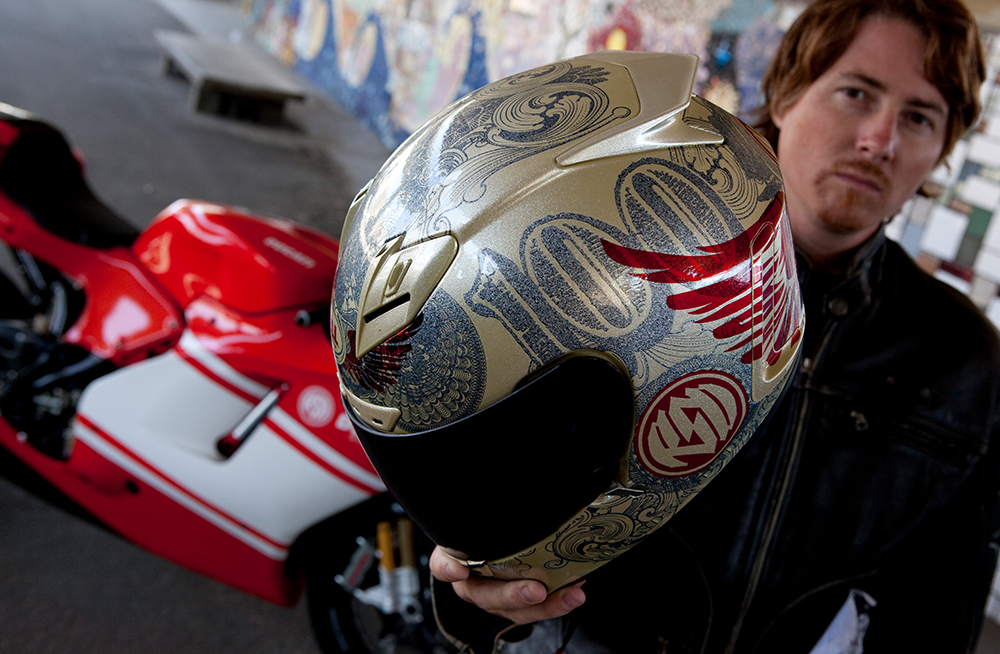
RSD X Bell Helmets
Breaking Down the Walls Between Performance and Custom Culture
The Challenge
As Bell Helmets prepared to build momentum around the Star helmet platform, the opportunity wasn’t just about launching another limited edition product. It was about reaching a new generation of riders in a way that felt real to them.
Motorcycle culture has always been fragmented into tribes: performance riders on one side, custom builders on the other. Each group carries its own identity, aesthetics, and values. But in reality, those boundaries have been blurring for years.
The challenge was to reflect that shift and create something that didn’t belong exclusively to either world.
Instead of designing for a single audience, the goal became designing a shared point of view.
The Approach
To bring that idea to life, the project partnered with Roland Sands, AMA champion, custom builder, and designer, whose work already lived at the intersection of performance and custom culture.
Roland wasn’t just a collaborator. He represented the exact overlap the project was trying to express. Someone who could move between racing pedigree and custom craftsmanship without contradiction.
The collaboration wasn’t treated as a typical co-branding exercise. It was positioned as a cultural statement about unity, creativity, and shared evolution within motorcycling.
The core idea was simple: performance and custom aren’t opposites. They’re just different expressions of the same passion.
Design Decisions
Every aspect of the project was built to reinforce that tension and harmony between worlds.
The helmet design itself balanced clean, performance-driven form language with the expressive, detail-rich aesthetic of custom motorcycle culture. Rather than choosing one direction, the design leaned into both, letting contrast become the defining feature.
To extend that narrative beyond the product, the visual storytelling needed to feel just as intentional.
The campaign partnered with award-winning photographer Rich Van Every to capture the project with a cinematic but grounded sensibility. The imagery avoided staged perfection in favor of atmosphere, texture, and authenticity, reflecting the lived reality of riders who move between disciplines.
Packaging was treated as an extension of the design experience rather than an afterthought. Premium luggage maker OGIO was brought in to create a custom helmet bag that matched the premium, collectible nature of the collaboration.
Every detail, from materials to structure to presentation was designed to feel intentional and elevated.
Building a Complete Experience
This wasn’t just a helmet launch. It was a fully realized cultural object.
Custom packaging, bespoke accessories, and carefully directed photography all worked together to reinforce a single idea: this collaboration was about breaking down old divisions in motorcycle culture and creating something new in the space between them.
The project treated every touchpoint as part of the same conversation, ensuring that the message carried consistently from product to photography to packaging to experience.
The Outcome
The RSD x Bell collaboration did more than introduce a limited-edition helmet. It created a visual and cultural statement that resonated across multiple segments of the riding community.
By bringing together Roland Sands’ dual identity in performance and custom culture, and pairing it with a fully considered design and storytelling system, the project challenged long-held assumptions about what motorcycle branding could look like.
The result was a release that felt less like a product drop and more like a shift in perspective.
It helped expand the conversation around the Star platform and set a tone for future collaborations, where contrast wasn’t something to resolve, but something to design around.